Discover effective fitness with concise, 30-minute bodyweight routines, often available as PDF guides, perfect for all levels – even beginners seeking total body transformation.
Benefits of Bodyweight Training
Bodyweight training offers remarkable advantages, making it ideal for a 30-minute workout, often found in convenient PDF formats. It requires no equipment, allowing workouts anywhere, anytime, reducing gym costs and travel time. These routines build functional strength, improving everyday movements and posture.
Furthermore, bodyweight exercises enhance muscular endurance, core stability, and flexibility. They are scalable for all fitness levels, with modifications available for beginners and progressions for advanced individuals. A 30-minute routine can effectively target multiple muscle groups, promoting full-body fitness. The accessibility and versatility of bodyweight training, especially through structured PDF plans, make it a sustainable and effective fitness solution.
Why 30 Minutes is Sufficient
Thirty minutes is a highly effective duration for bodyweight workouts, particularly when utilizing structured plans often available as PDF downloads. High-intensity interval training (HIIT) and Tabata-style protocols, commonly found in these routines, maximize calorie burn and muscle engagement within a short timeframe.
Efficient workout structures, like supersetting (1a, 1b), minimize rest and increase workout density. A focused 30-minute session, guided by a well-designed PDF, can deliver significant results, improving strength, endurance, and cardiovascular health. Consistency is key, and shorter, regular workouts are often more sustainable than infrequent, longer sessions. This makes 30-minute bodyweight routines accessible for busy lifestyles.

Workout Structure & Principles
Effective 30-minute bodyweight workouts, often found in PDF formats, leverage techniques like Tabata and supersets for maximum efficiency and results.
Tabata-Style Training Explained
Tabata training is a high-intensity interval training (HIIT) protocol frequently incorporated into 30-minute bodyweight workout PDFs. It involves performing an exercise at maximum effort for 20 seconds, followed by a 10-second rest period.
This cycle is repeated for eight rounds, totaling four minutes per exercise. The short bursts of intense activity, interspersed with brief recovery periods, are incredibly effective at boosting cardiovascular fitness, burning calories, and improving muscular endurance.
Many PDF workout plans structure entire sessions around Tabata intervals, often combining multiple exercises to target different muscle groups. This method maximizes workout efficiency, delivering significant results in a short timeframe.
Supersetting for Efficiency (1a, 1b)
Supersetting, a technique often detailed in 30-minute bodyweight workout PDFs, maximizes training efficiency by performing two exercises back-to-back with minimal rest. These are typically designated as 1a and 1b. For example, 1a might be push-ups targeting the chest, immediately followed by 1b, inverted rows working the back.
This approach keeps your heart rate elevated, enhancing calorie burn and muscular endurance. It also reduces overall workout time, making it ideal for 30-minute routines.
PDF guides often structure workouts with multiple supersets, targeting opposing muscle groups or different aspects of the same group for comprehensive training.
Importance of Proper Form
Maintaining correct form is paramount during 30-minute bodyweight workouts, often emphasized within detailed PDF guides. Prioritize technique over repetitions to prevent injuries and maximize effectiveness. Many resources, including video tutorials linked in PDFs, demonstrate proper execution.
Incorrect form can lead to strain on joints and muscles, hindering progress. Focus on controlled movements, engaging core muscles throughout each exercise.
PDF workout plans frequently include form cues and modifications for different fitness levels. Remember, quality repetitions build strength and endurance safely, ensuring long-term fitness success.
Sample 4-Week Bodyweight Workout Plan
Follow a structured 4-week plan, often detailed in a PDF, progressing from foundational exercises to peak performance, incorporating HIIT and varied routines.
Week 1: Building a Foundation
Begin your fitness journey with a focus on establishing proper form and building a solid base of strength. A typical PDF workout plan for Week 1 emphasizes fundamental movements.
Expect three sets of fifteen repetitions for push-ups, modifying as needed for beginner levels. Complement this with three sets of ten inverted rows, utilizing a sturdy table or similar structure.
Remember to prioritize controlled movements over speed, ensuring full range of motion. This initial phase is crucial for preventing injuries and preparing your body for increased intensity in subsequent weeks. Consistency is key during this foundational period, laying the groundwork for long-term success.
Push-Ups: Sets & Reps
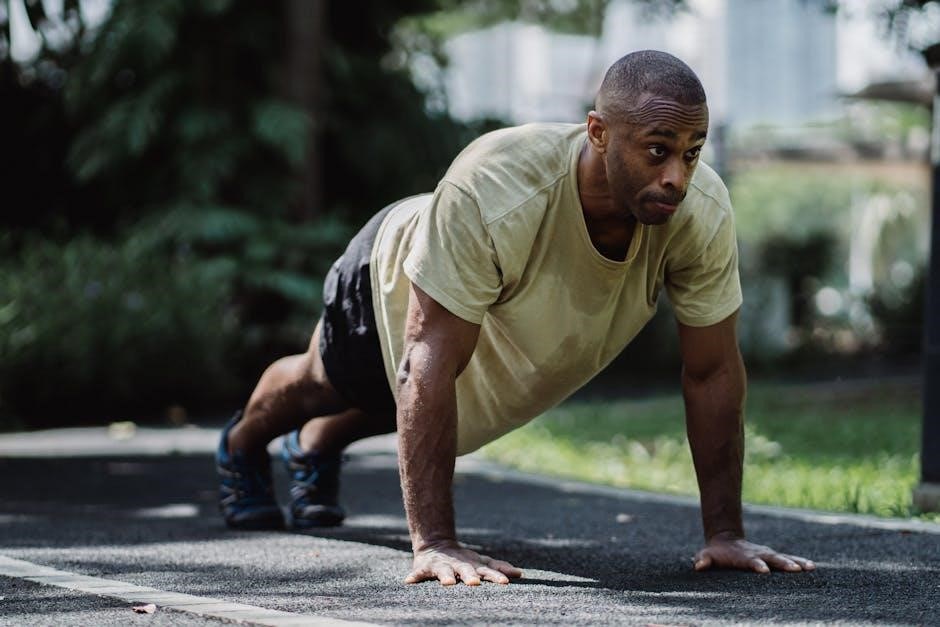
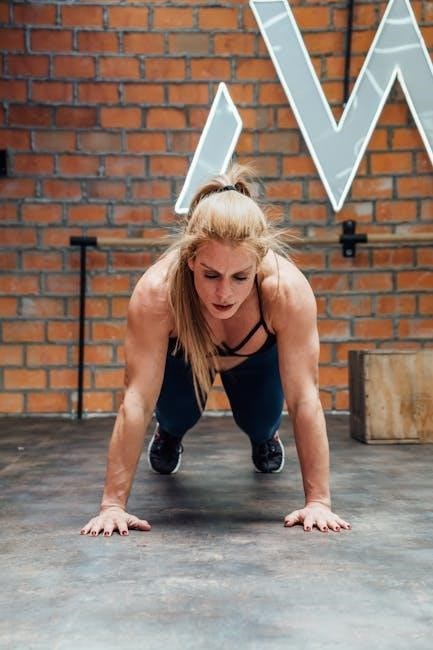
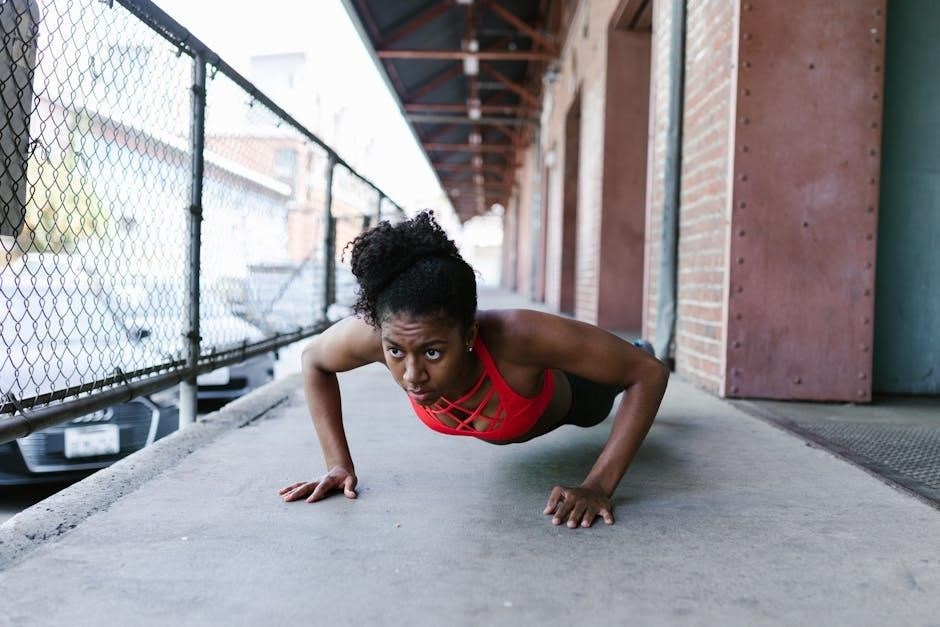
For Week 1, as often detailed in a 30-minute bodyweight workout PDF, aim for three sets of fifteen repetitions of standard push-ups. Beginners should feel free to modify by performing push-ups on their knees to maintain proper form.
Focus on controlled descent and explosive ascent, engaging your chest, shoulders, and triceps. Maintain a straight line from head to heels (or knees) throughout the exercise.
Rest for approximately 60 seconds between each set to allow for adequate recovery. Prioritize quality over quantity; if you cannot maintain proper form, reduce the number of repetitions. This builds a foundation for progression.

Inverted Rows: Sets & Reps
Within a typical 30-minute bodyweight workout PDF plan for Week 1, incorporate three sets of ten repetitions of inverted rows. You’ll need a sturdy table or bar positioned at a comfortable height. The lower the bar, the more challenging the exercise becomes.
Grip the bar with an overhand grip, slightly wider than shoulder-width apart. Keep your body straight, like a plank, and pull your chest towards the bar, squeezing your shoulder blades together.
Control your descent back to the starting position. Rest for 60 seconds between sets. Adjust the bar height to modify difficulty, ensuring proper form throughout each repetition.
Week 2: Increasing Intensity
As your body adapts, a 30-minute bodyweight workout PDF for Week 2 focuses on elevating the challenge. This is achieved by introducing push-up variations like incline or decline push-ups, targeting different chest muscle fibers.
For inverted rows, progress by lowering the bar height, demanding greater upper body strength. Consider adding a resistance band looped around the bar for increased difficulty. Maintain three sets, but aim for increased repetitions where possible.
Focus on controlled movements and proper form to prevent injury. This week builds upon the foundation established in Week 1, preparing you for more advanced exercises.
Adding Variations to Push-Ups
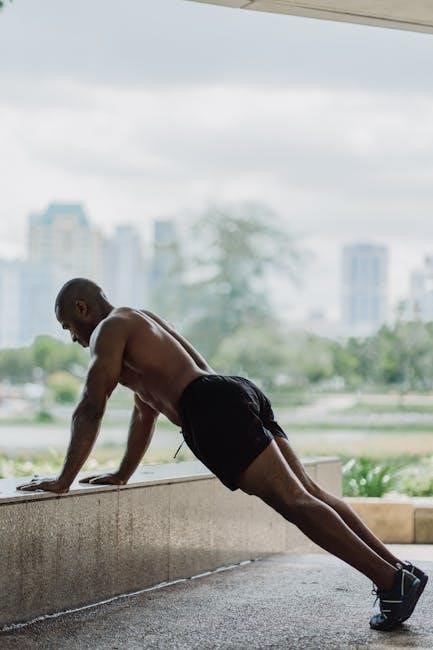
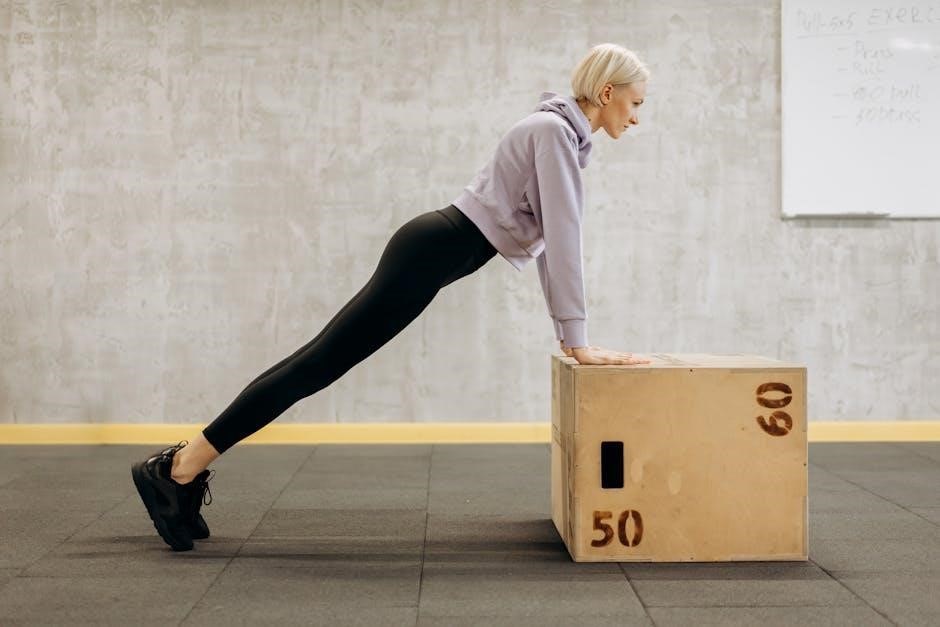
A 30-minute bodyweight workout PDF for Week 2 will likely introduce push-up variations to target different muscle groups and increase intensity. Incline push-ups, performed with hands elevated, reduce difficulty and emphasize the lower chest. Conversely, decline push-ups, with feet elevated, increase the challenge and focus on the upper chest.
Diamond push-ups, with hands close together forming a diamond shape, heavily engage the triceps. Wide-grip push-ups broaden the chest workout. Remember to maintain proper form throughout each variation, keeping your core engaged and back straight.
Gradually incorporate these variations into your routine, ensuring controlled movements and preventing strain.
Progressing Inverted Row Difficulty
A well-structured 30-minute bodyweight workout PDF, particularly in Week 2, will detail how to increase the challenge of inverted rows. Lowering the bar height significantly increases difficulty, requiring greater strength to pull your chest towards it. Adjusting your body angle also plays a crucial role; the more horizontal your body, the harder the exercise becomes.
Consider using a narrower grip to emphasize back muscles, or a wider grip to target the shoulders. For advanced users, adding a weight vest or resistance band can further intensify the workout. Maintaining proper form – a straight back and controlled movements – is paramount.
Focus on controlled negatives, slowly lowering yourself back down.
Week 3: Strength & Endurance
A 30-minute bodyweight workout PDF for Week 3 will emphasize building both strength and muscular endurance. This phase introduces lunges, demanding leg strength and core stability. Proper form is vital; maintain a straight back and controlled descent. Core engagement throughout the movement is key to maximizing effectiveness and preventing injury.
Focus on achieving a full range of motion in each lunge, ensuring your front knee doesn’t extend past your toes. The PDF should outline variations, like reverse lunges or walking lunges, to challenge different muscle groups.
Remember to prioritize controlled movements over speed, maintaining consistent tension.
Introducing Lunges with Core Engagement
A 30-minute bodyweight workout PDF will detail lunges as a foundational exercise, but emphasizes core engagement for enhanced stability and effectiveness. Actively draw your navel towards your spine throughout each repetition, preventing lower back arching. This protects your spine and maximizes glute and leg muscle activation.
Focus on maintaining a neutral spine and controlled descent. The PDF should illustrate proper form, highlighting the importance of keeping your weight balanced and your front knee aligned with your ankle.
Consider adding a slight pause at the bottom of the lunge to increase time under tension.
Focus on Range of Motion
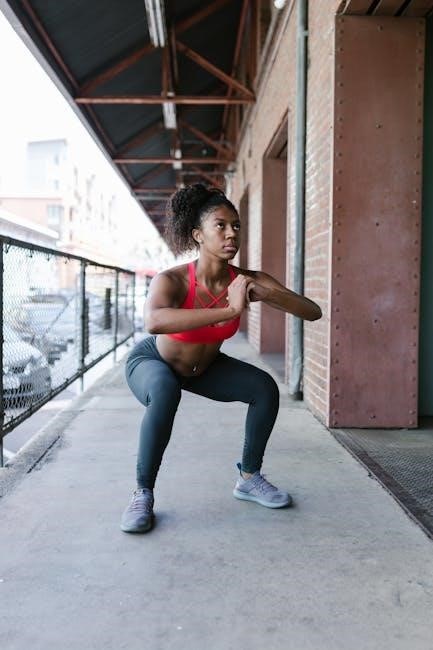
A comprehensive 30-minute bodyweight workout PDF stresses maximizing range of motion (ROM) during each exercise for optimal muscle fiber recruitment and flexibility gains. Don’t sacrifice form for depth; prioritize controlled movements throughout the full ROM.
For exercises like squats and lunges, aim to lower your body as far as comfortably possible while maintaining a neutral spine. This deeper range stimulates greater muscle growth and improves joint health.
The PDF should demonstrate proper ROM for each exercise, emphasizing the importance of feeling a stretch at the bottom and a contraction at the peak of the movement.
Week 4: Peak Performance
Your 30-minute bodyweight workout PDF’s final week focuses on maximizing results through combined exercises and high-intensity interval training (HIIT). Expect challenging routines designed to push your strength and endurance to their limits.
The PDF will likely incorporate full-body circuits, seamlessly linking exercises like push-ups, squats, and lunges to elevate your heart rate and burn calories efficiently.
Integrating short bursts of HIIT cardio – think burpees or jumping jacks – between strength sets further enhances fat loss and improves cardiovascular fitness. This week demands consistent effort and proper form.
Combining Exercises for Full-Body Impact
Your 30-minute bodyweight workout PDF will showcase how combining exercises maximizes efficiency and delivers a comprehensive, full-body challenge. Expect routines that move beyond isolated muscle groups, focusing on functional movements.
For example, a lunge with a bicep curl or a push-up followed immediately by a squat engages multiple muscle groups simultaneously, boosting calorie burn and improving coordination.
These combinations, often structured as supersets (1a, 1b – performed back-to-back with minimal rest), are key to achieving peak performance within the limited timeframe. The PDF will detail proper form for each pairing.
HIIT Cardio Integration
Your 30-minute bodyweight workout PDF will likely incorporate High-Intensity Interval Training (HIIT) cardio to amplify fat burning and improve cardiovascular health. HIIT involves short bursts of intense exercise followed by brief recovery periods.
Expect exercises like burpees, jumping jacks, and high knees integrated into the routine, often performed as intervals – for example, 30 seconds of work followed by 15 seconds of rest.
This approach maximizes calorie expenditure in a short amount of time, making it ideal for a 30-minute workout. The PDF will provide clear timing guidelines and modifications for different fitness levels, ensuring a safe and effective HIIT experience.

Specific Exercises for a 30-Minute Routine
A typical 30-minute bodyweight workout PDF features exercises targeting chest, back, legs, and core, often combining strength and cardio movements.
Chest & Arms Exercises
Bodyweight training for the chest and arms within a 30-minute routine, as often detailed in a PDF workout plan, prioritizes efficient, impactful movements. Push-ups are foundational, with variations like incline, decline, and wide-grip to target different muscle fibers. These can be incorporated into Tabata-style intervals or supersets for increased intensity.
Diamond push-ups emphasize triceps, while standard push-ups build overall chest strength. Inverted rows, utilizing a sturdy table or bar, effectively work the back and biceps, complementing chest exercises. A well-structured PDF will often demonstrate proper form for each exercise, minimizing risk of injury and maximizing results. Remember to focus on controlled movements and full range of motion.
Back & Shoulder Exercises
Effective back and shoulder work within a 30-minute bodyweight routine, often outlined in a downloadable PDF, focuses on exercises requiring minimal equipment. Inverted rows are crucial, utilizing a table or sturdy bar to build upper back strength and improve posture. Variations in hand placement adjust the difficulty and muscle focus.
Pike push-ups target the shoulders, mimicking a shoulder press. These, alongside scapular push-ups, enhance shoulder stability and strength. A comprehensive PDF workout will detail proper form to prevent injury. Combining these exercises with chest work creates a balanced upper body routine. Remember controlled movements and engaging core stability throughout each exercise for optimal results.
Leg & Core Exercises
Leg and core exercises are foundational in a 30-minute bodyweight PDF workout, building strength and stability. Lunges, a staple, can be modified with jumps or twists for increased intensity, targeting quads, glutes, and hamstrings. Squats, another essential, build lower body power. A well-structured PDF will demonstrate proper form to maximize effectiveness and minimize risk.
Core engagement is vital; planks, side planks, and bicycle crunches strengthen abdominal muscles and improve balance. Integrating core work with leg exercises, like lunges with a twist, enhances the workout’s efficiency. Remember to focus on controlled movements and maintaining a neutral spine throughout each exercise for optimal results and injury prevention.
Cool-Down & Recovery
Prioritize post-workout stretching, detailed in many 30-minute bodyweight PDFs, and consistent hydration to aid muscle recovery and enhance overall fitness gains.
Stretching for Muscle Recovery
Following a 30-minute bodyweight workout, incorporating a dedicated cool-down period focused on stretching is crucial for optimal muscle recovery. Many downloadable PDF workout plans emphasize this step, often including specific stretches targeting the muscle groups engaged during the session.
Hold each stretch for 20-30 seconds, focusing on deep, controlled breathing. Dynamic stretches, like arm circles and leg swings, can be performed initially, transitioning into static stretches – holding a position without movement – for major muscle groups.
Prioritize stretches for your chest, back, shoulders, legs, and core. This helps improve flexibility, reduce muscle soreness, and prevent injuries. Consistent stretching, as outlined in your 30-minute bodyweight PDF guide, will significantly enhance your recovery process and long-term fitness results.
Importance of Hydration
Adequate hydration is paramount when undertaking any fitness regimen, including a 30-minute bodyweight workout. Many PDF workout plans will highlight the necessity of replenishing fluids before, during, and after exercise to maintain performance and aid recovery.
Dehydration can lead to muscle cramps, fatigue, and reduced endurance, hindering your progress. Aim to drink water consistently throughout the day, not just when you feel thirsty.
Consider consuming electrolytes, especially after intense sessions, to replace those lost through sweat. Your 30-minute bodyweight PDF guide may offer specific hydration recommendations. Prioritizing hydration ensures optimal bodily function and maximizes the benefits of your workout.
Resources & Further Learning
Explore printable PDF workouts and online video tutorials to enhance your 30-minute bodyweight routine and achieve optimal fitness results.
Finding Printable PDF Workouts
Numerous online resources offer downloadable PDF workouts specifically designed for 30-minute bodyweight training. These guides often categorize workouts by fitness level – beginner, intermediate, or advanced – allowing for personalized progression. Many fitness websites and blogs provide free PDFs, while more comprehensive plans, like an 8-Week Bodyweight Workout Plan, may require a small investment.
Look for PDFs detailing Tabata-style workouts, a highly efficient method utilizing short bursts of intense exercise followed by brief recovery periods. These plans frequently structure routines around supersets (1a, 1b) performed back-to-back, maximizing workout efficiency. Before starting, preview the exercises to ensure proper form and understanding, as some routines incorporate unique, multi-functional movements.
Online Video Tutorials
Complementing PDF workout plans, a wealth of online video tutorials demonstrate proper form and technique for each exercise. Platforms like YouTube host numerous 30-minute bodyweight routines, often featuring modifications for varying fitness levels. Specifically, videos like the “30-Minute Bodyweight Workout” showcase expert guidance, with instructors like Alex demonstrating correct execution.
Visual learning is invaluable, especially when tackling unique movements or ensuring correct posture during exercises like lunges with core engagement. These tutorials often break down complex exercises into manageable steps, promoting safety and effectiveness. Searching for videos alongside your chosen PDF plan enhances understanding and minimizes the risk of injury, leading to optimal results.